Sunday, April 17, 2022

Daytime Shooting Star volume 9 (manga review)

A high school girl and boy look uncomfortable standing net to each other, but make sideways glances at the other indicating that they are actually romantically interested in each other
     This will be a short and sweet one. "Daytime Shooting Star" volume 9 (Shojo Beat) finally turns the tide from uncomfortable (immoral perhaps) almost relationship between a male teacher and a high-school student to being a more typical high-school romance between two high schoolers. 
    See my past reviews of this series to see why I was so skeeved out by it, but I had heard from others that the series would resolve in a much better way than it started. And at approximately the 2/3rds point, I see the light at the end of the tunnel.
    SPOILERS AHEAD:
    Summary, Suzume moves to live with her uncle, bumps into a cute guy who turns out to be her homeroom teacher and her uncle's friend. They fall for each other, and the ADULT just barely avoids starting an actual romantic relationship with her. Gross. Anyway, along the way, Suzume meets Mamura, a high-school boy who confesses to her, but while she's drawn to him as a friend, she is so stuck on her teacher, that she turns Mamura down. In volume 9, following on the promise of volume 8, Suzume and Mamura actually takes some steps forward as a potential couple, while Suzume continues trying to move on from her teacher. 
    END SPOILERS
    So thankfully, this series seems to be turning the corner and heading into more acceptable high-school romance territory. I'm going to stick it out to the end and I'll let you know. 
    As for the art, it really is above average. While it isn't quite up to the level of my favorites (I'm a sucker for 90s shoujo style, think Hana Kimi, Ouran High School Host Club, Clover by Clamp, etc... as well as mangaka's such as Io Sakisaka and Natsuki Takaya amongst others) it is certainly better than most of what's out there now which tends to have too cartoony and cutesy a style and less realistic. The art here bends towards realism without quite embracing the overly lanky and exaggerated shoujo style of the past that I love. I do love that the style of the faces is unique to this mangaka and I am quite drawn (pun?) to that face style. Even if the overall art isn't quite as beautiful as Io Sakisaka's art, it still is a plus for the series. (also, it does make pretty good use of screen tones which so many modern shoujo series seem to skimp on! >_<  And I LOVE screentones!!!!!)
    Should you read it? If you haven't started the series, maybe wait until I finish it to see if it's worth it. But if you have started and were as bothered by the initial adult/student relationship dynamic as I was, then things are going in a better direction and so it's probably worth seeing through to the end.

✩🚺

Please legitimately purchase or borrow manga and anime. Never read scanlations or watch fansubs. Those rob the creators of the income they need to survive and reduce the chance of manga and anime being legitimately released in English.

All comments are moderated by a real person who only checks them once a day. Therefore, comments may take a while before they show up. Thanks for understanding. It's how we keep this a community of lovingkindness.

Saturday, April 2, 2022

My Wandering Warrior Existence (Manga review)

    
This is an impossibly hard review to write. What is the proper balance between writing an honest personal review of a work of art, respecting both the person and the effort they took at creating the work, and any attempt to critique a work that is also a memoir and not pure fiction? Those are easy questions to answer when the reviewer unequivocally enjoys the work. However, it can feel icky when the reviewer doesn't enjoy the memoir as much. I don't ever want to judge another person. But should I comment on the craft behind telling the story? 
    Today, the memoir in question is "My Wandering Warrior Existence" by Nagata Kabi (Seven Seas), the fifth memoir manga in her series that began with her seminal, brilliant, heart-breaking, affecting manga "My Lesbian Experience with Loneliness."
    Essentially, "My Wandering Warrior Existence" suffers in relation to the extraordinary "My Lesbian Experience with Loneliness." In fact, I've felt that each volume since that first one has been one of diminishing returns. That doesn't mean they haven't been good, or powerful, but with each one maybe a little bit less so. Maybe it's that the freshness and uniqueness of "My Lesbian Experience" simply couldn't be recreated now that it was in the world - after all it was so unlike anything before it, but all her works after invariably must contain reflections of it. Or maybe it really is that the subsequent volumes simply aren't quite as excellent. But for whatever reason, "My Wandering Warrior Existence" feels like the slightest of the five volumes so far. 
    It is, of course, quite good actually. Her rough art has amazing charms. And her writing about herself is brutally honest. But on the whole, "My Wandering Warrior Existence" isn't necessarily as memorable or profound as the prior works. And yet of course, every reader is bound to connect with different things differently, so maybe for some, this will be your favorite so far. However, it began to feel less important to me as her story shifts from some of the more desperate, dark, and harrowing places in the previous volumes. This volume mostly focuses on Kabi's attempts to begin dating, or thinks about beginning to date, and for the most part doesn't mine the levels of desperation, illness, and pain of the prior volumes that gave them their gravitas and import as literature. 
    That being said, there is one very complex and personal thing that Kabi brings up in this volume. I won't spoil it, but it could also be quite tough for some readers and she does provide a trigger warning and the page numbers to skip through. Purely as a reader, I felt it quite difficult how Kabi reveals this truly horrific and major personal information but then also moves on from it very quickly and never returns to it. This is her truth and her life and her processing laid bare before us, so maybe this is really what it felt like to her and she was able to just move on. But at the same time, I wished she had either explored the implications of this in her life more thoroughly and what the healing process was like (or wasn't like)...or maybe hadn't brought it up at all. In some ways, this event could be seen as making everything in the prior four volumes make sense. And Kabi starts to talk about it with that level of significance but just as suddenly as this revelation is made, she moves on saying maybe it really isn't the cause of all her challenges after all. Huh? 
    I certainly don't expect anyone to expose themselves so openly and personally if they don't want to, but then why bring it up at all just to deny that it has any role in the larger life story she's telling through this manga series? I suspect because it does have a bigger role than she is ready to explore publicly right now (or maybe even admit to herself). 
    As a reader though it left me feeling badly. An analog for the feelings that this approach evoked in me might be similar to when your partner says they cheated on you years ago but felt horrible keeping the secret - they unburden themselves at your expense (BTW this has never actually happened to me, my [very few] ex's are all good people). Like, what are you supposed to do with this information now? You were happy a minute ago, thinking everything is fine. But after sharing, they get to feel better (no more guilt) and now you feel worse. I know that that is not at all a fair comparison to make. Kabi has no need to justify how much or what she does with anything she reveals in her work. But it was my honest emotional reaction to how this event is handled so briefly in this work, for better or worse. It left me feeling burdened with its enormity with no recourse.
    Other than this brief section, which occurs roughly halfway through the volume over the course of a couple pages, there are episodes about wedding photos, dating apps, grandchildren, and a lot of research about relationships. These are fine, occasionally humorous, sometimes a bit didactic, but often feeling more like filler. Which makes the volume feel like filler, i.e. just not up to par with some of the prior volumes. But let's say hypothetically there were to be a few more stunning volumes after this one, then if one were to read all of them together, the stories here might work in that larger arc. But as a self-contained volume about her thoughts on dating, it just didn't quite come together as cohesively (or as importantly) as the prior volumes.
    Is it good? Should you buy it? Did you like her other stuff and want to keep supporting her as a creator? It was okay and I will certainly keep buying new volumes from her as they come out. As I said in the beginning, I feel very icky trying to write a review of a memoir, because that is that person's life. And who am I to judge another person's life? But as a reviewer, I can look at the art of putting that story on the page, and in this case, "My Wandering Warrior Existence" didn't work as well for me as her prior volumes. The explosive freshness of "My Lesbian Experience with Loneliness" may simply not be a fair comparison for any other works by her. Yet it exists and can't be ignored. 

✩🚺

Please legitimately purchase or borrow manga and anime. Never read scanlations or watch fansubs. Those rob the creators of the income they need to survive and reduce the chance of manga and anime being legitimately released in English.

All comments are moderated by a real person who only checks them once a day. Therefore, comments may take a while before they show up. Thanks for understanding. It's how we keep this a community of lovingkindness.

Sunday, March 20, 2022

Daytime Shooting Star volumes 7 and 8 (manga review)

    I think the last time I wrote about "Daytime Shooting Star," I swore off finishing the series even though people told me that it ended better than it began. Well, I'm a completist and it was killing me to only have part of the series on my bookshelf, so I'm back to reading it. In this quick review, I touch on volumes 7 and 8.

Two manga covers, each depicting the faces of two teens

    Quick synopsis: Suzume moves from the country to Tokyo to live with her uncle when her parents go overseas (or something that parents seem to do in manga a lot). In Tokyo she meets a friend of her uncle's who just happens to be a teacher in her school. She falls for him. The question is whether he will fall for her, and whether anything will happen.
    And so if you've been reading this blog for any length of time you know that it is that premise which really really pisses me off. Adults should not have anything to do romantically with children ever. Especially educators. And the frequent depiction of "May/December" relationships between adults and high-schoolers in manga is deeply upsetting to me because it appears to normalize something that shouldn't be normalized. 
    Adults should, if they become aware of some infatuation from a child, either 1) ignore it, 2) make clear that nothing can happen ever, 3) stop all interactions with the child, or 4) some combination of all three. That's where "After the Rain," although it starts by veering into not good territory, actually handles those three points quite well and we see how the adult guides the teen back to a better place and away from the adult. 
    Thankfully, although it isn't done with the elegance of "After the Rain", volume 7 of "Daytime Shooting Star" does finally show the teacher taking some responsibility for the path he is going on and perhaps trying to make it right. I don't want to give anything away, so I won't go into details, but it's a start to maybe some repair work in this series. 
    Volume 8 goes a bit further as it reintroduces the teen boy character, Mamura as a potential love interest of Suzume. What somewhat bothered me is how the author conveniently has Suzume's friend Yuyuka fall for someone else after she seemingly had her eyes only on Mamura. While this clears the path for Suzume and Mamura to eventually get together (which of course would be healthier for her), it felt too convenient and easy to just brush aside Yuyuka and her story arc. 
    I think back to one of my favorite series, "Ao Haru Ride," and how Futaba and Yuri must work through their mutual crush on the same boy and how it affects their relationship. That was so well written. I am doubting we'll get that level of depth of writing in "Daytime Shooting Star." But at least maybe we can see Suzume realize she's better off with a fellow teen her age. 
    What I'm a bit worried about is that the teacher still admits to the uncle that he loves Suzume. So although he appears to end things in Volume 7, why isn't he questioning himself as to why he got so emotionally (and almost romantically) involved with a child? Sounds like he needs some serious therapy. I doubt we'll get that level of depth in the writing either.
    On the art side, I really do like the overall style. It's somewhere between the older shoujo style I love, and the newer more cartoony style. The facial expressions are great, and when it wants to, the art can be really well done. It's on the "plus" side for art quality.
    Should you keep reading this? Who knows. I will because I want to see where it goes and because I hate having partial series on my shelf. That being said, although maybe it has taken a turn for the better, I don't see it handling the rest of the story with any more depth, nuance, or maturity than it handled the first half. So I still think this will end up as a so-so series.

✩🚺

Please legitimately purchase or borrow manga and anime. Never read scanlations or watch fansubs. Those rob the creators of the income they need to survive and reduce the chance of manga and anime being legitimately released in English.

All comments are moderated by a real person who only checks them once a day. Therefore, comments may take a while before they show up. Thanks for understanding. It's how we keep this a community of lovingkindness.

Gender Queer is a phenomenal graphic novel (quick review)

Book cover for Gender Queer which depicts a young adult looking at their reflection in a lake of themselves as a child.
    Gender Queer, by Maia Kobabe, is a phenomenal, touching, and elegantly written graphic novel about a gender non-conforming/non-binary person who is also asexual. It is rare enough to get solid representation of and by someone in the non-binary community, but perhaps even more important is the exploration of asexuality and the intertwining dysphoria that accompanies both aspects of the author's experience.
    It covers roughly the first 25 or so years of the author's life, as E [note: E uses Spivak Pronouns] goes from a carefree early life to increasing pressure by the outside world to conform to (and confirm Eir) social gender norms. In addition, the treatment of menstruation, gynecological visits, body dysphoria, and so much more is laid bare for non-binary/asexual readers looking for an image of themselves in media, and for those looking to better understand non-binary and/or asexual experiences.
    One of the things about this graphic novel that was most impactful to me was the somewhat dispassionate (and I mean that as a compliment) style of both the writing and art. There is nothing performative, nothing trying to make some grand point, nothing overly emotional in the presentation. This is almost a journalistic memoir in it's clear, simple retelling of various experiences in Eir life. Rather than undermine the value and insight of the memoir, that style serves to make the actual insight more profound because it is not presented through any intense layers of emotion that might distract or detract for some readers. I found it to be incredibly moving, insightful, and beautiful and the style of both art and writing served it extremely well.
    Many of you may have heard or come across Gender Queer in that conservative media has been bashing it as pornography. It is not. There are some moments where sexual acts are depicted, but they serve as points for unpacking internal experiences, sensations, feelings, and understandings of self. They most definitely are not depicted pornographically or for any eroticism or titillation . Like I said in the paragraph before, the whole thing has a slightly dispassionate, journalistic quality, further emphasizing that this is not porn. 
    Worryingly, even the New York State Education Department came out against this book recently in a disappointing way when the pulled a twitter post from the state librarian championing this book and its personal meaning to her and her child. [Tweet posted below this review for posterity because it has been removed from twitter]. Lauren Moore is the head of all libraries in the state, not just school libraries, but public libraries, research libraries, state university libraries, and was absolutely correct to give this graphic novel a personal shoutout because it is most definitely appropriate to adult, teen, and maybe even some younger readers. It is so disappointing that the government can't even respect freedom from censorship and the LGBTQ+ community in what is supposed to be a liberal state. (And for those who know me, I am risking my job over this post because NYSED was not pleased with me when I wrote to them directly with my concern over their response and statement, but that's a story for another day).
    So although this review is coming out well after the graphic novel was published, I wanted to respond to the March 2022 dust up with New York State and give this graphic novel another bit of positive press. It is a truly beautifully written, drawn, and observed memoir about two underrepresented and frequently misunderstood aspects of the LGBTQ+ continuum. I highly recommend it.
Tweet from Lauren Moore stateing "I chose "Gender Queer: a Memoir" by Maia Kobabe. I'm grateful for books that let my kid know they're not alone."
What a beautiful statement that should have been entirely non-controversial.

✩🚺

Please legitimately purchase or borrow manga and anime. Never read scanlations or watch fansubs. Those rob the creators of the income they need to survive and reduce the chance of manga and anime being legitimately released in English.

All comments are moderated by a real person who only checks them once a day. Therefore, comments may take a while before they show up. Thanks for understanding. It's how we keep this a community of lovingkindness.

Saturday, March 5, 2022

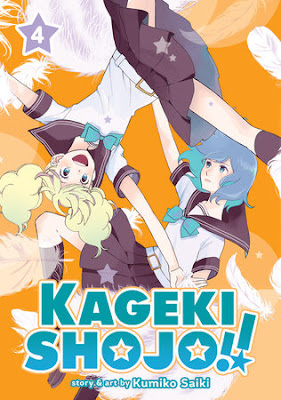
Kageki Shojo volume 4 (manga review)

Two high school girls with feathers falling around them
    I want to love this series, but "Kageki Shojo" volume 4 (by Kumiko Saiki, published by Seven Seas) just spins it's wheels and keeps us at arm's length from our lead character.
    "Kageki Shojo" is the story of an all-girls performing arts school where the goal is to enter the adult all-female performance troupes upon graduation. Watanabe Sarasa is the tall, goofy, high-energy, raw talented, odd-ball who is also positioned, maybe destined, to be a great and unique talent. Should be an amazing series, right? Sadly, this volume doesn't do anything meaningful and in four volumes, I'm not getting a good feeling for this series living up to it's early promise.
    Volume 4 focuses on a once-a-decade school sports festival where the main competitors are the adults from the performance troupes. It is set up as a type of fan service to the fans of the performance troupes. By various circumstances, Watanabe Sarasa has to fill in for one of the adult performers. Of course, her elevation to this position should be a source of great drama amongst the other students, but by and large, that just doesn't come to fruition. While some grumbling is hinted at, four volumes in, everyone seems to have more or less accepted our odd-ball with the high-ceiling untapped talent. Which makes it pretty drama free. 
    In addition to there being no real inter-personal conflict, there is no intra-personal conflict either. Yes, you might say that the whole end of volume 3 (she must find who she is as an actress instead of perfectly mirroring other's great performances) has it's fulfillment in this volume. But it wasn't enough. There is no interiority which how Watanabe is written. We don't really know what she's thinking or feeling or struggling with, not in any depth. (If you read this with any regularity, you know I like my characters with angst) The story is told too much from a third person perspective without enough internal insight. And with little meaningful plot or inter-personal conflict instead, there just isn't much actually happening. Hence my "spinning it's wheels" comment earlier. 
    What continues to be most sad for me as I read this series, is that the prequel volume "Kageki Shojo: The Curtain Rises" focused on Watanabe's roommate, Narata Ai, who is much more interesting and is given much more internal conflict. She's beautiful, somewhat famous already, but an outcast in many ways, with complex internal emotions, she holds others at a distance, and her outcome and destiny are not as clearly fixed as Watanabe's. 
    In fact, I always read Narata's arc with the potential to be very open ended and potentially sad. She was a teen idol in an idol group, who was the outcast of that group. Her move to the Kouka school almost has the feel of going into exile, almost like Maria in "Sound of Music" going back to the nunnery. So what will this hold for her? Will she continue on to join Kouka's troupe? Will that make her happy? Does she long for something else? Is that something else in entertainment, or is it something totally different? There's so much to explore with her character. I so wish that we got more of Narata in the main series. I really wish she was the main character in the main series. She is simply more interesting.
    So "Kageki Shojo" volume 4 is fine. The art is somewhat simple, but still engaging. What little conflict there is is fairly superficial, the plot itself isn't that interesting, and we don't really get any insight into the lead character. I just don't know where this series is going, or what it's trying to say or be. Or maybe, I do, and it's too simple an outcome and I'm looking for something more that will never be there. (shrug). Ah well, it's not bad, I'll keep reading it, but it isn't great either. It's just sort of fluff.

BTW, this is the 300th post on this blog!

✩🚺

Please legitimately purchase or borrow manga and anime. Never read scanlations or watch fansubs. Those rob the creators of the income they need to survive and reduce the chance of manga and anime being legitimately released in English.

All comments are moderated by a real person who only checks them once a day. Therefore, comments may take a while before they show up. Thanks for understanding. It's how we keep this a community of lovingkindness.

Love at Fourteen volume 11 (manga review)

This manga cover shows a teen boy and girl in a field
    
If you've read any of my prior reviews of "Love at Fourteen" volumes, this one will sound awfully familiar. Unfortunately "Love at Fourteen" volume 11 (by Fuka Mizutani, published by Yen Press) exhibits the same juxtaposition of a truly wonderful main couple with absolutely morally and ethically fraught romantic relationships between adults and children. In short, if you aren't already committed to seeing this series through (and I've toyed with stopping multiple times, but I'm a "completist") then don't bother starting now.
    Kazuki and Kanata are nearing the end of their middle school life together with Kazuki set to move away soon. This volume focuses mostly around a class ski trip. What is beautiful about this volume is the clear eyed, sweet, and very well written relationship growth between Kazuki and Kanata. Although this volume, like many before it, keeps minimizing our time with the main couple in favor of the side couples, what it did offer with Kazuki and Kanata is some of my favorite writing in the series. I don't want to spoil anything, because it comes late in the volume, and it's just a really unique thing to see in a manga, or most stories about middle-schoolers.
    But that hardly makes up for this volume's faults (which mirror the series' faults). And that is we have two adults who are in seriously flirtatious situations with middle school students. These are children. And under no condition should adults even take a first step in that direction with children. This series does nothing to comment critically on that, and instead, seems to try and find beauty in these burgeoning relationships. I'm not okay with that at all. And I keep seriously thinking about stopping the series. I'm not proud of myself that I haven't. I keep thinking each volume might be the last. It's not a good excuse. I shouldn't give this author any more of my money, no matter how good the main couple's story and writing is.
    In addition to the two side couples that are an adult and 14-year-old, there is a third adult, the school nurse who has an interesting dynamic with another teen. There is a truly, and uncharacteristically, aggressive scene in this that left me quite uncomfortable. It's played off as a type of defensiveness but it reads as manipulative and emotionally unstable by the adult. Yuck. It then also positions the child to try and be this adult's "savior." Double yuck.
    There just seems to be so many manga series about May/December (to use an awful euphemism for predatory) adult/child relationships. I think "Love at Fourteen" is one of the most dangerous because the whole series is supposed to have this gentle, wistful tone which tends to minimize the issue here. An issue which the series NEVER critically comments on. This isn't a series that warns against the dangers of this type of relationship. It's not even a series that presents any hint of danger for anyone involved in these types of relationships. It's like it is normalizing it. 
    The only time I have ever read a manga about a teen/adult relationship that was remotely appropriate in how it was handled and commented on was "After the Rain" in which the adult recognized what was going on, set clear boundaries, and made it his responsibility to push her back towards being a teen and living the life she was supposed to lead. He actually helped her heal the issues that drove her to crush on him. He acted like a responsible adult. While that series is certainly not criticism free, it was a really solid attempt at exploring a young woman with a crush on an older man and how the man could actually be a decent human being and help the child stay a child.
    In "Love at Fourteen" we have two, and maybe three, predatory adult women who are actively flirting with 14 year-olds. And it's not even a game to them or something darker or more malevolent. They are clearly depicted as being romantically interested in these children. NOT OKAY EVER!
    So basically, while the mangaka has some clear writing skill, she is using it for some not good storylines. If this series would just stick solely to the main couple, Kanata and Kazuki (both teens), it would be a brilliant, beautiful series. But volume 11 typifies and advances all the problems in this series. 

✩🚺

Please legitimately purchase or borrow manga and anime. Never read scanlations or watch fansubs. Those rob the creators of the income they need to survive and reduce the chance of manga and anime being legitimately released in English.

All comments are moderated by a real person who only checks them once a day. Therefore, comments may take a while before they show up. Thanks for understanding. It's how we keep this a community of lovingkindness.
Saturday, February 26, 2022

Wolf Girl and Black Prince (re-watched the anime - Review)

Wolf Girl and Black Prince
    
I hadn't seen "Wolf Girl and Black Prince" in many years. And I didn't particularly remember anything about it, either good or bad. Usually I at least have some vague feelings about a show that I've watched in the past but haven't re-watched for some reason, usually lukewarm feelings. And then there are the couple of shows so upsetting that I either didn't finish them or vowed never to watch again. But I honestly couldn't remember anything about "Wolf Girl and Black Prince" so when I needed a romance show to kill some time, I decided to rewatch it.
    Long story short, it really sends the wrong message to girls/women. I don't know if I didn't see it at the time, or just forgot, but this show is made up of two of the most terrible tropes in shoujo/romance anime/manga: 1) that rude hot guys secretly have hearts of gold and 2) that a spunky, plucky girl can heal their wounds and change them for the better. Ughhhhh. And that is literally the entire premise of this series.
    The good: it's got an amazing opening theme song (posted at the end of this). And Erika, our heroine, becomes a bit more likeable as the show goes on, but not by much.
    The bad: Kyoya, our boy, is just so consistently awful to her. He manipulates her, he's mean to her, he says unforgivable things (which she forgives him for). He's emotionally closed off. He's really verbally and emotionally abusive to her through the entire show and she just keeps coming back for more and excusing him and forgiving him, and it's just awful to watch. We're supposed to excuse him because we know he's secretly a good guy (and the occasional gesture in that direction is supposedly enough to excuse all his awful behavior). 
    There are also at least two disturbing homophobic/transphobic jokes in the series that serve absolutely no narrative purpose (It's like rewatching "Friends" and forgetting how many gay jokes they made). In one scene, the joke is that parents would be upset if their slightly effeminate son (read: emotionally kind, soft-spoken, nice) might turn out to like men (heaven forbid!). In the other, Erika mistakenly thinks a transwoman is Kyoya's mom. Of course the transwoman (or possibly a drag performer, not sure how they want us to read this character) is presented in the most stereotypical way possible: huge muscular chest and arms, slinky dress, 7 feet tall, overbearing. I don't know about you, but this transgirl (gestures to self) weighs all of 130 lbs and there is a lot more diversity in the trans community than the stereotype presented here which only reinforces the terrible and wrong views on transwomen (I'm looking at you Texas governor!). Either way, these moments are played for comedy at the expense of LGBTQ people and it's not okay. It is, though, sadly typical of a lot of anime/manga from this time-period. It seems to slowly be getting better, but not by much.
    In some ways, this show reminded me of when I tried to re-read "Peach Girl" recently (considered a classic shoujo series) and realized that the two main boys are just so horrible to the girl from the very get-go. It was so disturbing to read, and the boy's terrible temperaments and treatments of her were so normalized, that I couldn't get past the first few volumes of my re-read. How did I ever make it through that series years ago? Did I not realize how truly awful it was back then? It's disturbing to think that I might not have recognized it or been as disturbed by it before. "Wolf Girl" is not much better. Although I did force myself to watch all the way through just in case I was missing something (I wasn't).
    Should you watch this series? No. There is nothing in it that is really redeeming. This show follows a long line of cruel, cold-hearted men in shoujo manga who are "redeemed" by the loving girl (I'm looking at you "Bokura ga Ita" - consistently ranked as a great shoujo manga, and the classic "Kare Kano" which is quite disturbing to read now - including how the heroine sacrifices all her goals and future for the shitty closed-hearted boy). This is some of the most dangerous messages we could be sending. To promote a message like this is setting up girls/women to tolerate abuse. It is never okay for men to treat women like this, no matter what happened to them in their past, we should never be holding up a man like that as an object of pursuit, and we should certainly not be teaching girls/women to put up with anything in the belief they can change a hurtful person if they just love them harder.
    Do yourself a favor and watch or read all the amazing series out there instead. If you must engage in the "hurt boy is healed by the stubbornly persistent girl" trope, then at least do do with "Blue Spring Ride" (Ao Haru Ride) which has bits of this type of storyline, but explores it in a much more nuanced, sensitive, and acceptable way. There are even bits of it in "Chihayafuru" but again, done better without the outright abuse that Erika takes in this series. And of course, there are so many wonderful romance and romantic-comedy shoujo series out that that don't use this set-up at all. Find yourself a series with a nice boy who treats the girl nicely ("Kimi ni Todoke" comes quickly to mind). Because that's what we should be holding up as the expectation.

Here's the amazing opening theme though by Special Thanks (I've had it on my phone so long, I didn't even realize it came from this series):

✩🚺

Please legitimately purchase or borrow manga and anime. Never read scanlations or watch fansubs. Those rob the creators of the income they need to survive and reduce the chance of manga and anime being legitimately released in English.

All comments are moderated by a real person who only checks them once a day. Therefore, comments may take a while before they show up. Thanks for understanding. It's how we keep this a community of lovingkindness.